


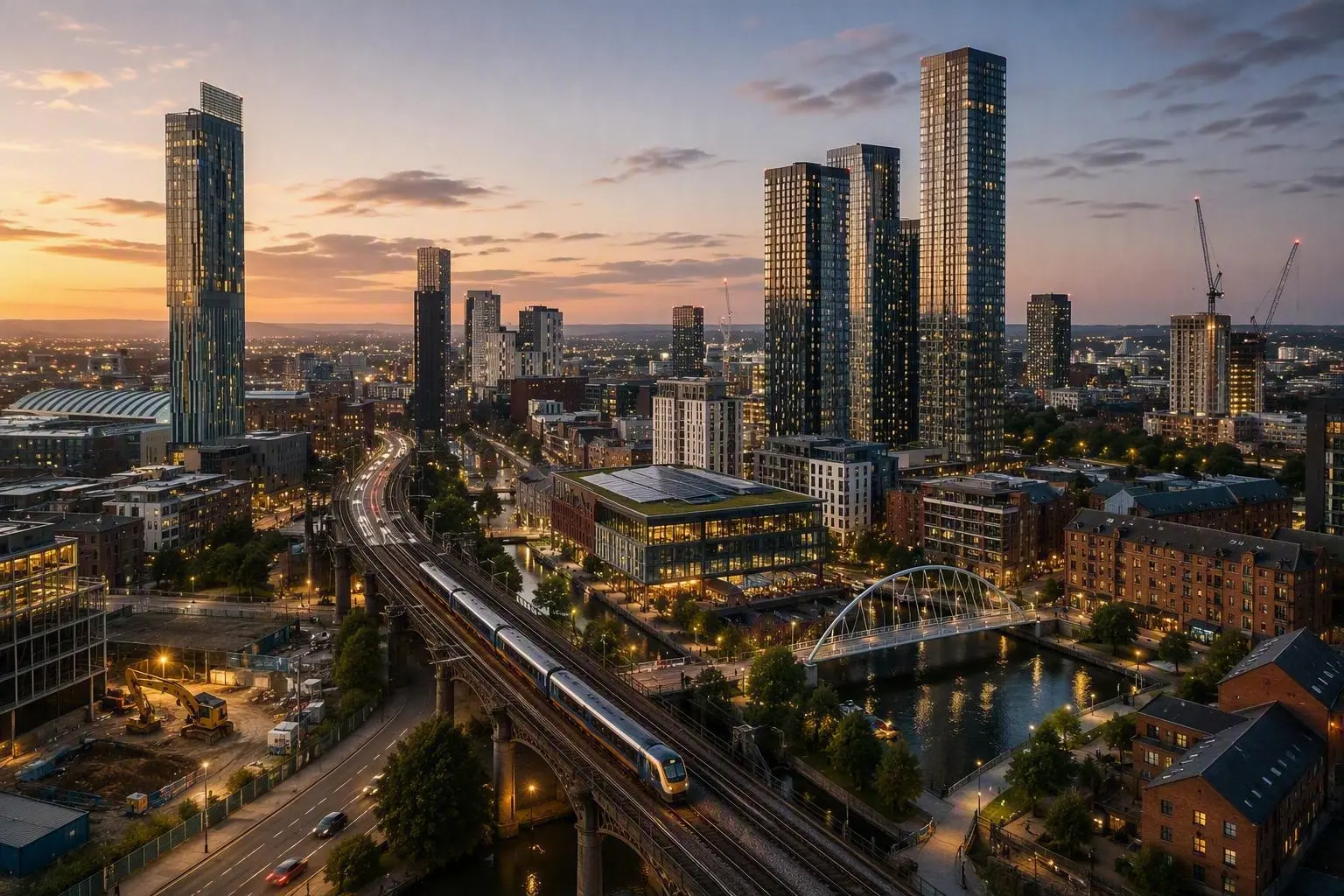
Greater Manchester’s real advantage lies in its ability to connect research capability, investment programmes and infrastructure demand; creating an environment where solutions can be tested, deployed and commercialised. The opportunity extends far beyond simply attracting more businesses to the region. This combination has the potential to position the region not just as a centre for innovation, but as a leading environment for transforming innovation into deployment and scale.
The right foundations
Few UK regions can match the density of institutions turning research into commercial technology here. The University of Manchester and Bruntwood SciTech’s Sister innovation district is expected to create over 10,000 new jobs.[1] KPMG has also highlighted Manchester’s rapidly scaling technology ecosystem and developments such as Atom Valley, an emerging hub for advanced materials and green technology projected to deliver around 20,000 jobs as part of an environment supporting long-term private-sector growth.[2],[3] Manchester-based Cellerate, part of the Infratech cohort analysed in our report, builds automated systems for battery manufacturing, and has already worked with Atom Valley’s Centre of Expertise in Advanced Materials and Sustainability (CEAMS) to refine its laser-cutting processes, a live example of these environments already at work.[4]
Greater Manchester’s emergence is being supported by a wider push to strengthen the region’s infrastructure and digital economy. The city of Manchester hosts the Innovation Greater Manchester partnership, set up to drive research, productivity and innovation,[5] and has been selected to host the planned Civil Service Digital Campus. It has also recently secured a further £420m to fuel growth across the region’s industrial, infrastructure and construction sectors.[6] Together, these developments are creating fertile ground for Infratech companies looking to test, deploy and scale their solutions close to home, with access to major regional programmes, public-sector partners and a growing pipeline of infrastructure demand.
Manchester’s wider investment appeal provides another sign of the strength of that proposition. EY’s 2026 UK Attractiveness Survey found that Manchester remained the UK’s leading city for foreign direct investment outside London in 2025, with technology being the city’s leading source of FDI.[7] For a region looking to build globally competitive innovation clusters, that international pull is an important advantage, bringing capital, businesses and expertise into an already growing technology ecosystem.
Why local government matters here
Greater Manchester’s advantage lies not only in what is being built, but in who has the power to build it. Since its first devolved mayoral election in 2017, Greater Manchester has continued to deepen its autonomy, most recently through a 2023 “trailblazer” settlement where it became one of the first English regions, alongside the West Midlands, to secure a single, flexible funding pot, a model since extended to other city regions.[8] Local leaders, not Whitehall, hold real control over transport, skills, housing and regeneration spending, giving Manchester a strong mix of locally controlled authority and delivery capacity.
That combination of devolved decision-making and delivery capacity gives Greater Manchester an important advantage: the ability to connect its innovation ambitions with the places where new solutions can actually be deployed. That reach across multiple areas of local investment means the region is well placed to create real-world opportunities to test and adopt new infrastructure solutions.
This kind of regional investment matters because it builds the conditions Infratech businesses need to succeed: live projects, engaged public and private sector partners, and a pipeline of demand for new solutions. Capital alone is rarely enough for Infratech companies to scale. What separates businesses that grow from those that stall is access to credible deployment opportunities; and Greater Manchester is increasingly well placed to offer exactly that.
Recent changes to government procurement rules could strengthen the opportunity further. Measures designed to reduce barriers for smaller businesses competing for contracts and prioritise local job creation may create a more favourable environment for growing Infratech companies to demonstrate their value in real-world applications.[9]
There are already signs of what this next phase could look like. Greater Manchester’s 5G Innovation Region has moved beyond early testing, applying advanced wireless technologies across housing, care and transport and preparing connected solutions for wider adoption.[10] The next phase will build on that work, with Smart Transport Corridors acting as testbeds for further innovation and plans to develop a regional digital twin.[11]
Together, these developments strengthen Greater Manchester’s position as a leading environment for Infratech deployment. The next challenge is to connect the region’s institutions, programmes and infrastructure owners more systematically, creating a clear pathway from research to pilot, from pilot to procurement, and from regional adoption to national scale.
[1] Sister, 2026. “Sister”. (Accessed: September 2026).
[2] KPMG, 2026. “Why the North West means business – and delivers”. (Accessed: September 2026).
[3] Atom Valley, 2025. “The Vision”. (Accessed: September 2026).
[4] Atom Valley, 2026. “CEAMS: Cellerate”. (Accessed: September 2026).
[5] Innovation Greater Manchester, 2026. “About”. (Accessed: September 2026).
[6] Greater Manchester Combined Authority, 2026. “Mayor unveils next wave of Good Growth as Greater Manchester bids for biggest ever Ryder Cup.” (Accessed: September 2026).
[7] EY, 2026. “London tops Europe for tech investment as UK leads digital FDI”. (Accessed: September 2026).
[8] Department for Levelling Up, Housing & Communities, 2023. “Greater Manchester Combined Authority Trailblazer deeper devolution deal”. (Accessed: September 2026).
[9] Cabinet Office, 2026. “Government orders that public spending must back British jobs and skills in every postcode”. (Accessed: September 2026).
[10] Department for Science, Innovation and Technology, 2026. “5G Innovation Regions: successful regions”. (Accessed: September 2026).
[11] Greater Manchester Combined Authority, 2026. “GM 5G Innovation Regions programme”. (Accessed: September 2026).
A gateway, not just a growing region
For founders, location is only part of the equation. Turning regional opportunities into commercial growth requires access to customers, projects and industry expertise. Murphy Capital can help bridge that gap by connecting emerging solutions with live-deployment opportunities.
Greater Manchester is our home. Being based here puts us close to the founders, businesses, partnerships and projects shaping the region’s innovation landscape, giving us a first-hand view of the next generation of infrastructure solutions.
Our ability to support those businesses extends well beyond the region. Murphy operates across the UK, Ireland, Canada, the US, Australia and New Zealand. This gives Murphy Capital portfolio companies the ability to move from a strong regional position into a wider UK and international delivery network, driven by an £8.2bn order book.
This combination of deep regional roots in a thriving ecosystem and the reach of a global infrastructure operator is what makes Murphy Capital distinctive. Beyond investment, portfolio companies gain a route into industry experts, commercial environments and routes to deployment that would otherwise take years to access.
Further insight into the investment trends shaping UK Infratech is explored in Murphy Capital’s newly published report UK Infratech: From Innovation to Scale.
To learn more about Murphy Capital and how we support Infratech businesses from Greater Manchester and beyond, visit our website www.murphy.capital.